Emerging Market Inflows Slowed to $21.7 Billion in February
Non-resident investors added $21.7 billion to emerging market portfolios in February. The IIF described the slowdown as a normalization after a record January.

Foreign investors significantly reduced their purchases of emerging market assets in February, with net inflows falling to $21.7 billion. This represents a sharp decline from the record $100.5 billion seen in January and is lower than the $45.5 billion recorded during the same month last year. The Institute of International Finance (IIF) reported that despite the slower pace, flows remained positive across both debt and equity segments.
Jonathan Fortun, a senior economist at the IIF, noted that the month-to-month deceleration reflects a return to normal levels following an exceptional start to the year.
The month-to-month slowdown is best read as a normalization after an outlier January print.
Non-resident investors allocated $14.3 billion to emerging market debt, while equity inflows reached $7.4 billion, down from $28.0 billion in January. These figures were recorded prior to a shift in global risk sentiment caused by tensions involving the United States, Israel, and Iran. The geopolitical situation in the Middle East has since led to a broader retreat from risk assets in early March.
Debt inflows during February were distributed across several regions, with Asia attracting $5.9 billion and Latin America receiving $4.3 billion. China saw $400 million in debt market inflows, while emerging markets outside of China captured $13.8 billion. This suggests a continued appetite for higher-yielding assets in diverse markets.

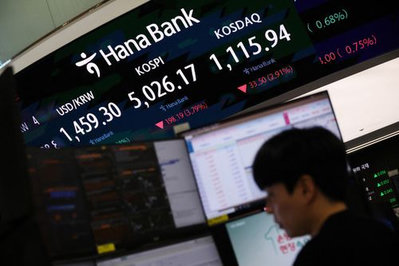
Equity flows remained positive but showed regional disparities. While China stocks attracted $5.2 billion, other emerging markets added $2.2 billion. Latin America led regional equity allocations with $6.9 billion. Conversely, Asia equities saw net outflows as selling in South Korea offset gains in other regional markets. Despite the recent outflows, the South Korean KOSPI index remains strong for the year.
Fortun emphasized that investor decisions are becoming increasingly selective based on economic fundamentals.
In this environment, flows are likely to remain broadly resilient but increasingly differentiated, with balance sheet strength, policy credibility, and market depth playing a growing role in shaping investor allocation decisions.
Local currency bond markets continued to draw interest as investors sought yields in countries with stable exchange rates. However, the IIF highlighted a localized instance of volatility in Indonesia, which saw sharp outflows from sovereign bonds and equities due to domestic concerns. The organization noted that this trend remained contained and did not impact the wider emerging market landscape.