Chips Take Six Months. The Box That Powers Them Takes Twenty-Nine.
Tony P.IUX24 Research Team

Latest version only
TopicsPolicy & Regulation


Latest version only
The AI industry, photographed honestly.
For fifty years, software was an escape from the physical world. Zero marginal cost. Infinite copies. No factory. The whole business model of Silicon Valley rested on the fact that shipping one more copy of a program costs nothing.
AI reversed that. The frontier of software is now poured in concrete, measured in megawatts and cooled with water. Every additional smart answer requires physical machines, physical electricity, and physical heat taken somewhere else.
That change has already rewritten which companies make money, and most of the winners are firms nobody in tech thought about ten years ago.
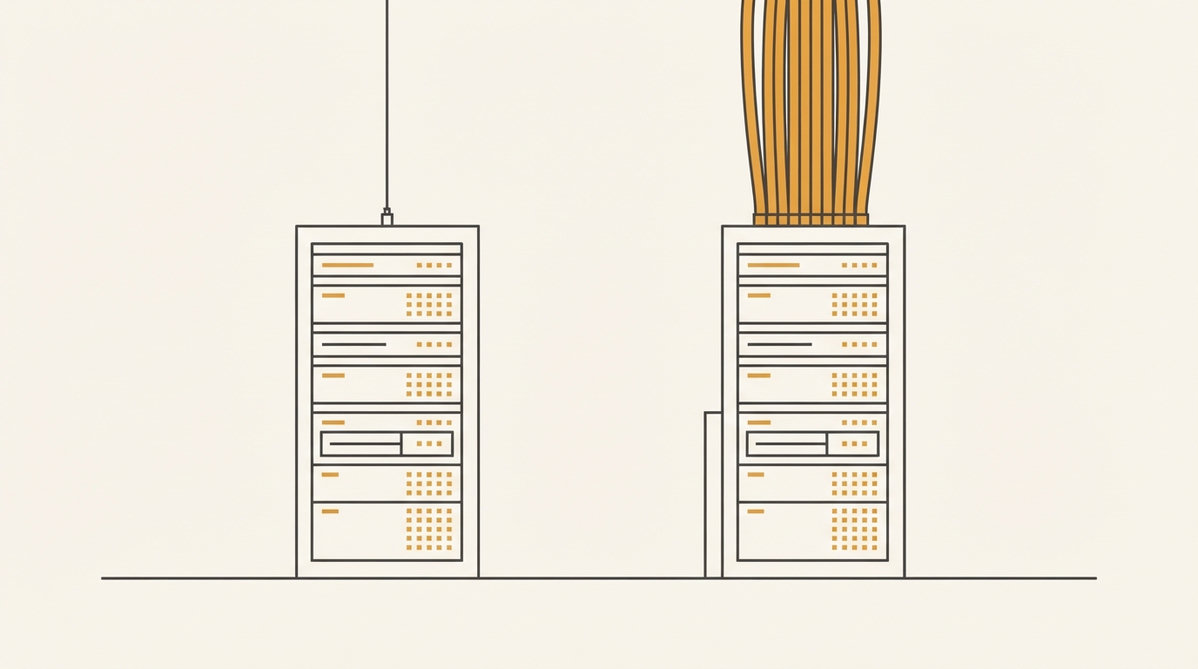
A traditional rack of servers — the kind that ran the internet for two decades — draws about 5 to 10 kilowatts.
A flagship AI rack draws 120 kilowatts. The next generation is projected to approach 600.
That's a 60 to 100-fold jump in power density in under a decade: the electrical demand of an entire neighbourhood packed into a phone booth. Every problem in the rest of this article is a consequence of that one number.
Same cabinet. The old rack ran on a thread; the AI rack needs a bundle as wide as itself.
Scale it up and a large AI campus wants a gigawatt or more — roughly the output of a full-size nuclear reactor, enough for about a million homes. Individual companies are planning several campuses of that size. Data centres consumed around 4 to 5% of US electricity going into this boom; credible projections put them at 9 to 17% by 2030.
The US grid was built brilliantly, decades ago, for demand growing one or two percent a year. AI showed up asking for tens of gigawatts immediately.
Two bottlenecks matter, and neither is about technology.
The interconnection queue. To plug a large facility into the grid you file a request and wait while utilities study whether the grid can take you. That line runs four to five years. Hundreds of gigawatts of projects sit in it, the overwhelming majority of them data centres — multiples of the entire peak demand of a large state, waiting.
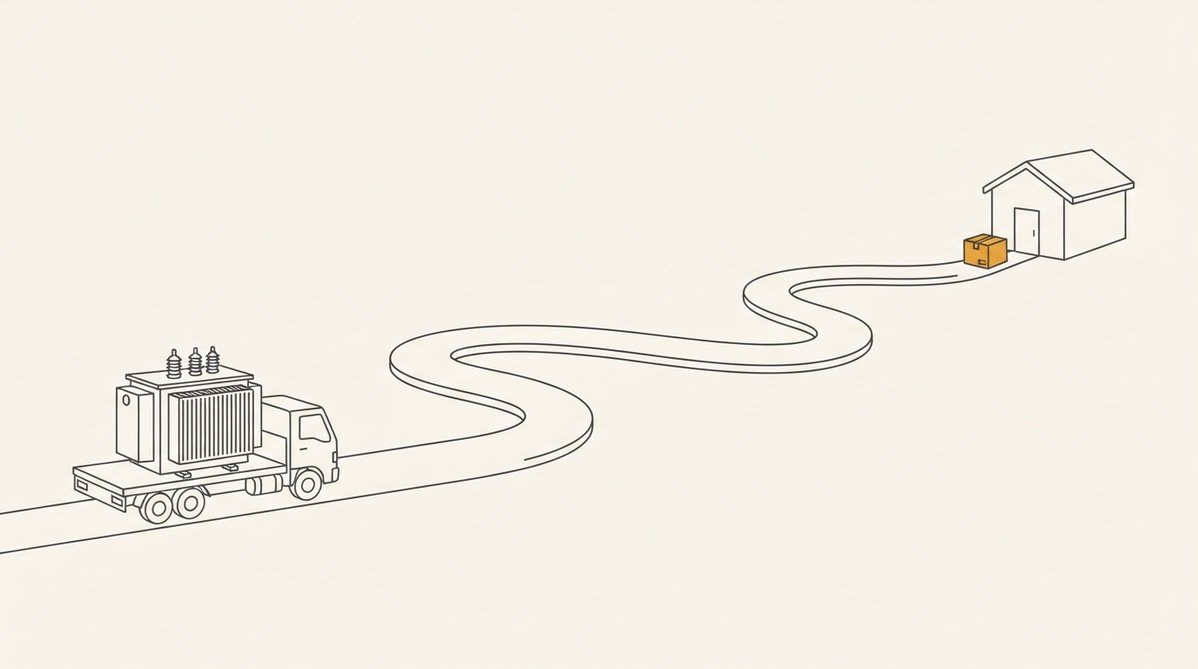
The transformer. The grey box that steps voltage down used to take about a year to order. Now it's two and a half to four years, at prices up by most of a doubling.
Read those together: you can have your chips in six months and the box that powers them in twenty-nine. When the scarce input stops being silicon and becomes electrical steel and a queue position, the industry stops looking like technology and starts looking like construction.
The chips are already at the door. The transformer they need has barely left.
So the buyers went around the grid. The industry calls it behind-the-meter: generate power on site or next door, and never join the public queue at all. That decision, made simultaneously by every large buyer, lit a fire under an entire forgotten sector.
Nuclear, restarted. A twenty-year agreement was signed to bring an 835-megawatt reactor back online — the undamaged unit next to the one from the 1979 accident at Three Mile Island — with one software company buying every megawatt it produces. The moat here is beautifully simple: you cannot build a new conventional nuclear plant in America this decade, so existing reactors are irreplaceable and suddenly the most valuable energy assets on the continent. AI factories run around the clock, and nuclear is the only carbon-free source that also runs around the clock.
Small modular reactors get the headlines and deserve the scepticism. These are pre-revenue companies whose first commercial electron arrives around 2030 at the earliest, some without final regulatory approval for their designs. That isn't a business yet. It's an option on the 2030s.
Fuel cells, because speed beats elegance. If the grid takes four years and nuclear takes ten, what can you install in twelve to eighteen months? Boxes that convert natural gas to electricity chemically, parked behind the meter. The sector's leader has also drawn a public dispute with a short-seller-affiliated research outlet over how much of its marketed backlog is actually binding — which is its own lesson: when a backlog number and the filings disagree by a wide margin, the burden of proof sits with the company.
Gas turbines, the least glamorous and probably the best business in the whole layer. Gas is realistically the only thing that can be built at scale before 2030. The dominant maker's turbine slots are sold out through the end of the decade, with a backlog in the hundreds of billions and essentially one global rival at scale.
Then the layer nobody thinks about. Between the substation and the chips sit switchgear, busways, and uninterruptible power supplies — giant batteries that catch the load instantly if the grid blinks, because a half-second outage can destroy a training run that's been going for a month. Three companies own this layer, and their backlogs have grown at rates that industrial equipment firms simply do not post.
And the last line of defence: rows of diesel generators the size of school buses, idling for the one hour a year the grid fails.
Physics 101: almost all of that electricity becomes heat. The factory is running a fever.
A single flagship AI chip dissipates over a thousand watts — a postcard-sized object putting out the heat of a full-size space heater. Stack seventy-two of them in a rack with their memory and networking and you have the output of about eighty space heaters in a cabinet.
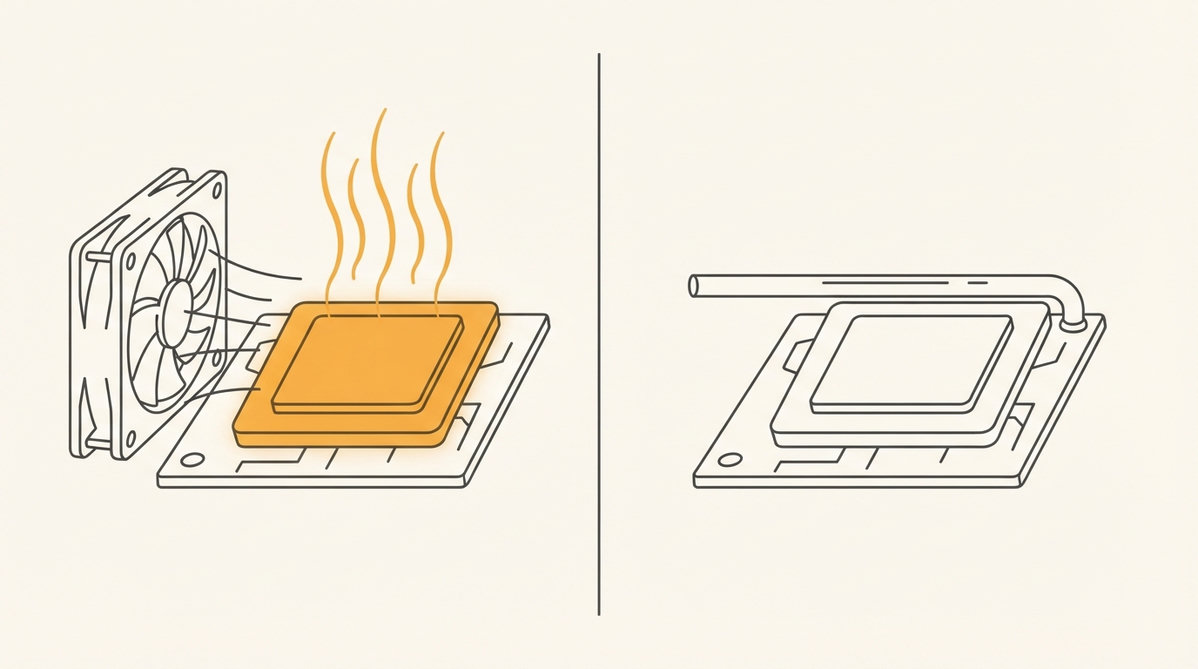
For thirty years the answer was air conditioning: cold air up through the floor, hot air out the back. Air works up to roughly 30 to 50 kilowatts per rack. We passed that line permanently. Moving 120 kilowatts with air would take hurricane-force wind through the servers.
So the industry is going through the biggest plumbing change in its history. Water carries heat about 3,000 times more effectively than air per unit volume. A metal plate with liquid channels sits directly on each chip, hoses carry the heat to a distribution unit, and the flagship racks do not offer this as an option — they require it.
The fan runs flat out and the chip still cooks. One thin line of water and it doesn't.
Two numbers investors will meet. PUE is a factory efficiency score: total power divided by power that actually reaches the computers. Old facilities run around 2.0, meaning a watt of cooling for every watt of computing. Modern liquid-cooled sites reach about 1.1. That gap, multiplied by a gigawatt and an electricity price, is real money.
And water itself. Many facilities cool by evaporating millions of gallons, which has become a genuine permitting fight in dry regions. Closed-loop systems help. Watch it anyway — it decides where buildings get sited.
The clearest signal in this whole layer isn't a product. It's that both of the big electrical equipment groups spent billions buying their way into liquid cooling within months of each other. When disciplined industrial acquirers pay up for the same niche at the same time, they are telling you what they think every future data centre looks like.
This is the part that gets left off investor maps, and it shouldn't be.
Data centres bid for scarce power, and they bid against everyone else. In the market covering thirteen states from Illinois to Virginia, data centre demand added over nine billion dollars to a single capacity auction, which translates into residential bills rising sixteen to eighteen dollars a month in parts of Ohio and Maryland.
Communities noticed. Moratoriums are being proposed. Any honest picture of this build-out has to include the possibility that the constraint which finally bites isn't transformers or turbines — it's a county council.
The story of AI in this decade is no longer mainly a story about chips. Chips are the part that moves fastest, and fast-moving parts are rarely the bottleneck.
The bottleneck is a queue position, a transformer, a turbine slot, a cooling loop, and a permit. All of them are boring, all of them take years, and all of them are owned by companies that spent decades being described as mature.
That's what happens when software becomes heavy industry: the profit moves to whoever owns the heavy part.
Comments