
Australia and EU Sign Trade Deal for Critical Minerals
The pact removes tariffs on most EU goods and Australian minerals to cut reliance on China. Farmers criticized the deal for limited agricultural market access.

Australia and the European Union have finalized a landmark trade agreement after eight years of negotiations, aimed at removing tariffs on nearly all European goods and Australian critical mineral exports. The deal represents a strategic effort to diversify supply chains and reduce economic reliance on China, particularly regarding rare earths and essential minerals. This shift is seen as a response to the geopolitical landscape, including trade policies from the United States and the global race for resources. Industry leaders such as LYNAS RARE EARTHS LTD and ILC CRITICAL MINERALS LTD are expected to benefit from the removal of import duties on minerals entering the European market, which aims to stabilize global supply networks.
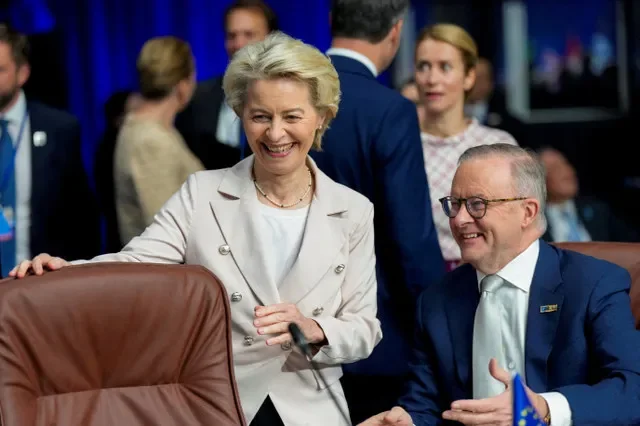
Beyond trade, the two parties signed a separate agreement to bolster security and defense ties. European Commission President Ursula von der Leyen highlighted the geopolitical significance of the partnership during a statement.
"With these dynamic new partnerships on security and defence, as well as trade, we are moving even closer together."
The pact is expected to eliminate over 1 billion euros in annual duties for European companies, with EU exports to Australia projected to grow by up to 33% over the next decade. Australian Prime Minister Anthony Albanese noted that the deal would contribute approximately A$10 billion annually to the national economy. Von der Leyen further addressed the Australian parliament regarding the importance of the critical minerals partnership.
"We cannot be over-dependent on any supplier for such crucial ingredients, and that is precisely why we need each other."
The deal marks a significant expansion of European influence in the Indo-Pacific, following similar trade accords established with Indonesia and India.
Despite the broad removal of tariffs, Australian agricultural sectors expressed dissatisfaction. While the EU will remove tariffs for many products, key exports like beef and sheep meat will be subject to strict quotas. Hamish McIntyre, president of the National Farmers Federation, voiced the industry's concerns.
"Australian farmers are extremely disappointed that negotiations for a free trade deal with the European Union (EU) have concluded without commercially meaningful agricultural market access gains since Australia last walked away from negotiations."
The agreement also provides protection for European geographical indications, covering products such as Pecorino Romano and Ouzo. However, some producers of goods like feta may continue using those names if they include clear origin labeling. Furthermore, Australia has agreed to raise the luxury car tax threshold for European electric vehicles to A$120,000, exempting roughly 75% of EVs from the region from the tax. Trade between the two sides remains substantial, with the EU serving as Australia's third-largest two-way trading partner in 2024.