Lagarde warns of rate hikes amid Middle East conflict
Lagarde says the ECB may raise rates if the Iran conflict fuels persistent inflation. Policymakers will reassess economic data at every upcoming meeting.

European Central Bank President Christine Lagarde has signaled a potential shift toward raising interest rates in the euro zone if the conflict involving Iran triggers a sustained inflationary spike. While the ECB opted to leave rates unchanged during its most recent session, officials are now debating the specific triggers that would necessitate higher borrowing costs to prevent price growth from becoming entrenched.
Lagarde noted that the central bank is prepared to act decisively if inflation appears likely to remain above its 2% target for an extended period. She suggested that even a moderate overshoot could require a policy adjustment to maintain public confidence in the bank's mandate.
"If the shock gives rise to a large though not-too-persistent overshoot of our target, some measured adjustment of policy could be warranted."
The warning comes as the geopolitical instability begins to affect the broader European economy. Business sentiment has notably weakened in Germany, while economists in Portugal and Italy have cautioned that the region could face slower growth or even a recession if energy costs remain volatile.
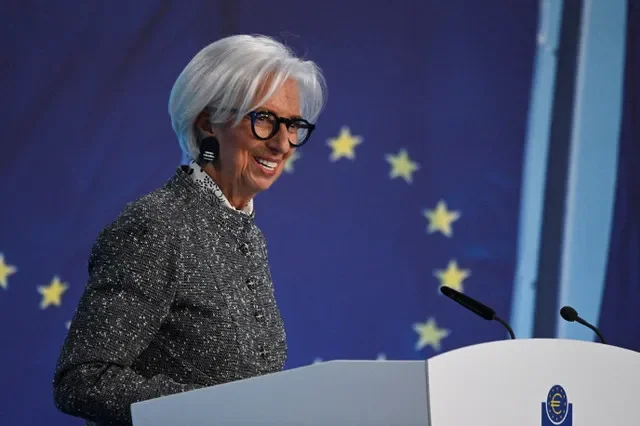
Bank of Finland governor Olli Rehn, speaking at the same event in Frankfurt, argued that monetary policy should focus on the overall macroeconomic landscape rather than reacting solely to fluctuations in energy prices. This perspective suggests the bank will look past the immediate volatility affecting commodity-linked entities like Oil-Dri Corporation of America to assess medium-term stability.
"Monetary policy must respond, from the standpoint of medium-term price stability, to the overall macroeconomic environment, not to oil prices alone."
The ECB is currently monitoring several economic scenarios. In its baseline projection, inflation is expected to average 2.6% this year. However, more severe outcomes—which could impact energy infrastructure firms such as Natural Gas Services Group, Inc.—might see inflation peak above 6% and remain elevated for years. Lagarde clarified that the bank's response would be proportional to the persistence of the deviation.
"If we expect inflation to deviate significantly and persistently from target, the response must be appropriately forceful or persistent."
ECB Chief Economist Philip Lane added that policymakers will evaluate these scenarios at every meeting, keeping the possibility of a rate hike in April or June on the table. While financial markets have already priced in the potential for multiple hikes this year, Lane observed that investors currently view the energy price surge as a temporary level jump rather than a permanent inflationary trend.
Lagarde also addressed concerns that the ECB might be repeating past mistakes by acting too slowly, as it did during the 2021-2022 inflation cycle. She argued that the current situation is fundamentally different, citing a less constrained labor market and higher existing interest rates as buffers against the current shock.
"As expected deviations from our inflation target grow larger and more persistent, the case for action becomes stronger."
Despite the bank's readiness to act, a majority of economists surveyed by Reuters anticipate that the ECB will maintain its current interest rate levels for the remainder of the year, pending further data on wage growth and price-hike expectations.